
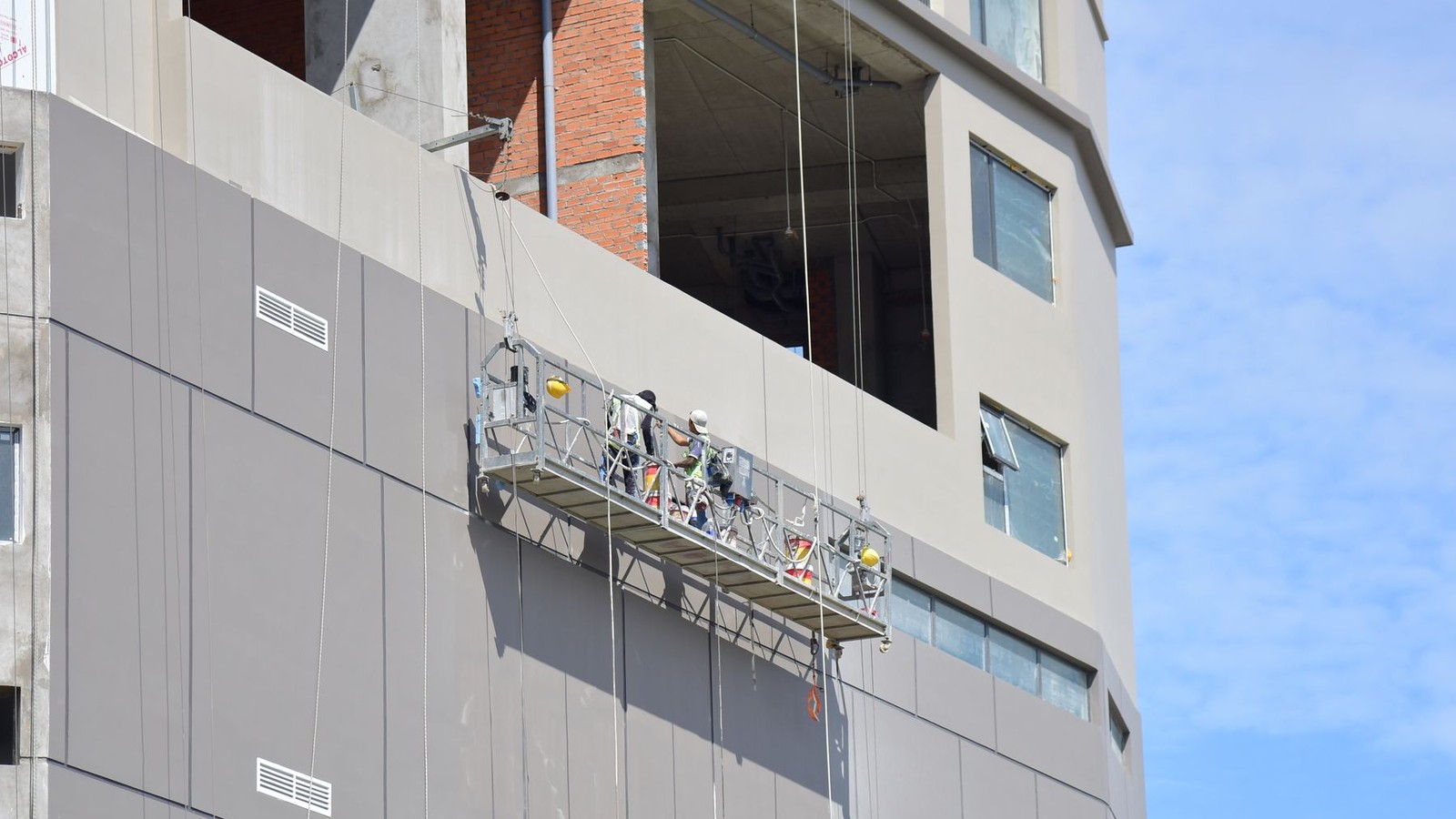
Why Painting a 15-Story Tower Isn't a Painting Job: Swing Stages, Wind Windows, and What Your Bid Should Include
Three bids come in for painting your 15-story tower. One is 40% below the others. The board wants to know why, and the low bidder's answer is that they "run a leaner operation."
Sometimes that's true. More often, the gap is scope — specifically, the scope that doesn't appear on a residential painting proposal because it doesn't exist on a residential job. Access, wind management, containment, and surface preparation on a high-rise are not line items you can trim without changing what you're buying.
Here's what a real high-rise painting scope contains, and how a board or property manager can read three bids and see which one is actually complete.
Access is the project, not a detail
On a two-story building, access is a ladder. On a 15-story tower, access is an engineered system with its own design, its own inspections, and its own line in the budget — frequently a significant percentage of the total.
Suspended scaffolds (swing stages) require roof anchorage that has been evaluated and certified for the loads, outrigger beams or parapet clamps set by qualified people, independent lifelines separate from the stage's suspension, and daily pre-use inspection. Anchors on many older Southwest Florida buildings were never designed for this, or were installed decades ago and have never been re-certified. Finding that out is part of pre-construction, not a surprise for week three.
Rope access can be faster and less intrusive on some elevations, but it's a certified discipline with its own rigging requirements, not simply "guys on ropes."
Mast climbers and boom lifts may be better for certain elevations, and each brings ground-space requirements that collide with parking, landscaping, and resident access.
A bid that doesn't name the access method for each elevation hasn't priced the job. It has priced painting and left access as a variable to be resolved — at your expense — later.
Wind windows: the schedule constraint nobody puts in the proposal
Suspended work has hard wind limits. Industry practice and most manufacturers put the working ceiling for swing stage operations around 25 mph, and many contractors come down well before that as gusts build.
Now apply that to a Gulf Coast tower. Wind speed increases with elevation, so the upper floors reach the shutdown threshold before the lower floors do. Sea breeze patterns mean many days have a usable morning and an unusable afternoon. Summer brings daily convective storms and lightning holds. Hurricane season adds full de-rigging events — you cannot leave a stage hanging when a named storm approaches, and re-rigging is a real cost and a real delay.
The practical result: a high-rise exterior painting project in SWFL does not have a linear schedule. A contractor who has done a lot of them will tell you the realistic calendar duration including weather days, and will explain how they sequence elevations to keep crews productive when one side is unworkable. A contractor who quotes you a tidy number of working days without mentioning wind hasn't run this job before.
Ask directly: What is your wind shutdown threshold, who makes that call, and what does your schedule assume for weather days?
Preparation is where the money and the lifespan are
Paint on a high-rise fails from underneath. Almost always. The coating didn't fail — the substrate did, or the prep did.
A complete scope names each of these:
- Pressure washing at a specified pressure with a specified cure/dry time before coating. Too much pressure damages stucco; too little leaves chalk and biological growth that no coating will bond through.
- Stucco and concrete repair, with a unit price and an estimated quantity. This is the single biggest source of change orders on tower work, because you cannot know the full extent of spalling and delamination until you're on the wall with a hammer. A good bid includes an allowance and a unit rate so the number is predictable rather than negotiated mid-project.
- Crack treatment that distinguishes hairline shrinkage cracks from moving structural cracks. Static cracks get filled; moving cracks need an elastomeric bridging treatment or they'll telegraph through the new coating within a season.
- Sealant replacement at window perimeters, control joints, and penetrations — full removal of the old joint, backer rod, and new sealant, not a bead over the failing one. This is the work that keeps water out of the wall, and skipping it is the most common way to get a beautiful building that leaks.
- Primer specification matched to the substrate condition, including a bonding or masonry primer where chalking is heavy.
If two bids differ by 40%, compare the repair allowances and the sealant scope first. That's usually the whole gap.
The coating system, specified properly
"Two coats of exterior paint" is not a specification. What belongs in the bid:
- Manufacturer, product line, and system — primer plus topcoats, named.
- Mil thickness, wet and dry, per coat. This is the number that determines whether you got what you paid for, and it's measurable in the field. An elastomeric system typically needs substantially more material than a standard acrylic to achieve its rated performance — spread too thin, it's just expensive paint.
- Whether the system is elastomeric or a high-performance acrylic, and why that choice fits your building's substrate and moisture behavior.
- The manufacturer's warranty term and what maintains it.
The line items owners forget until they're a change order
- Containment and overspray protection for vehicles, landscaping, pool decks, and adjacent property. Overspray claims on a tower can dwarf the value of the disputed work.
- Resident coordination — notices, balcony clearing schedules, window and slider closure requirements, and who communicates it. On an occupied building this is a real labor cost.
- Balcony and railing work, which is often a separate scope entirely and needs to be sequenced with the wall coating.
- Roof protection from anchor points and traffic, and repair of any penetrations created.
- Insurance limits and workers' comp verification for a crew working at height over public space. Ask for certificates naming the association.
- Milestone inspection or SIRS interaction — if repairs uncover conditions that touch your structural reserve obligations, you want a contractor who understands the reporting implications rather than one who quietly patches and moves on.
How to compare three bids in ten minutes
- Lay the scopes side by side, not the totals. Circle every item that appears on one and not the others.
- Find the stucco repair allowance and unit price on each. Normalize them to the same quantity before you compare totals.
- Check the sealant line. Full removal and replacement, or a bead over existing?
- Check the mil thickness spec. If it isn't there, the coating quantity isn't defined.
- Check the access method per elevation and whether roof anchor certification is included or excluded.
- Ask each bidder for two SWFL high-rise references from the last three years, and call them.
Once those are normalized, the bids usually land much closer together — and the one that's still low is low for a reason you can now name.
Talk to a contractor who does this every season
McLeod's Construction, Paint & Restoration has been handling commercial high-rise painting, waterproofing, and concrete restoration for condominium associations, property managers, and commercial owners across Lee, Charlotte, and Collier Counties for more than 30 years — 50+ employees, 3,000+ completed projects, and Florida license CGC1535021. Your project. Our passion.
If you're evaluating bids or building a scope for your next painting cycle, call us at (239) 282-0891 or reach out through mcleodsconstruction.com and we'll walk the building with you.