
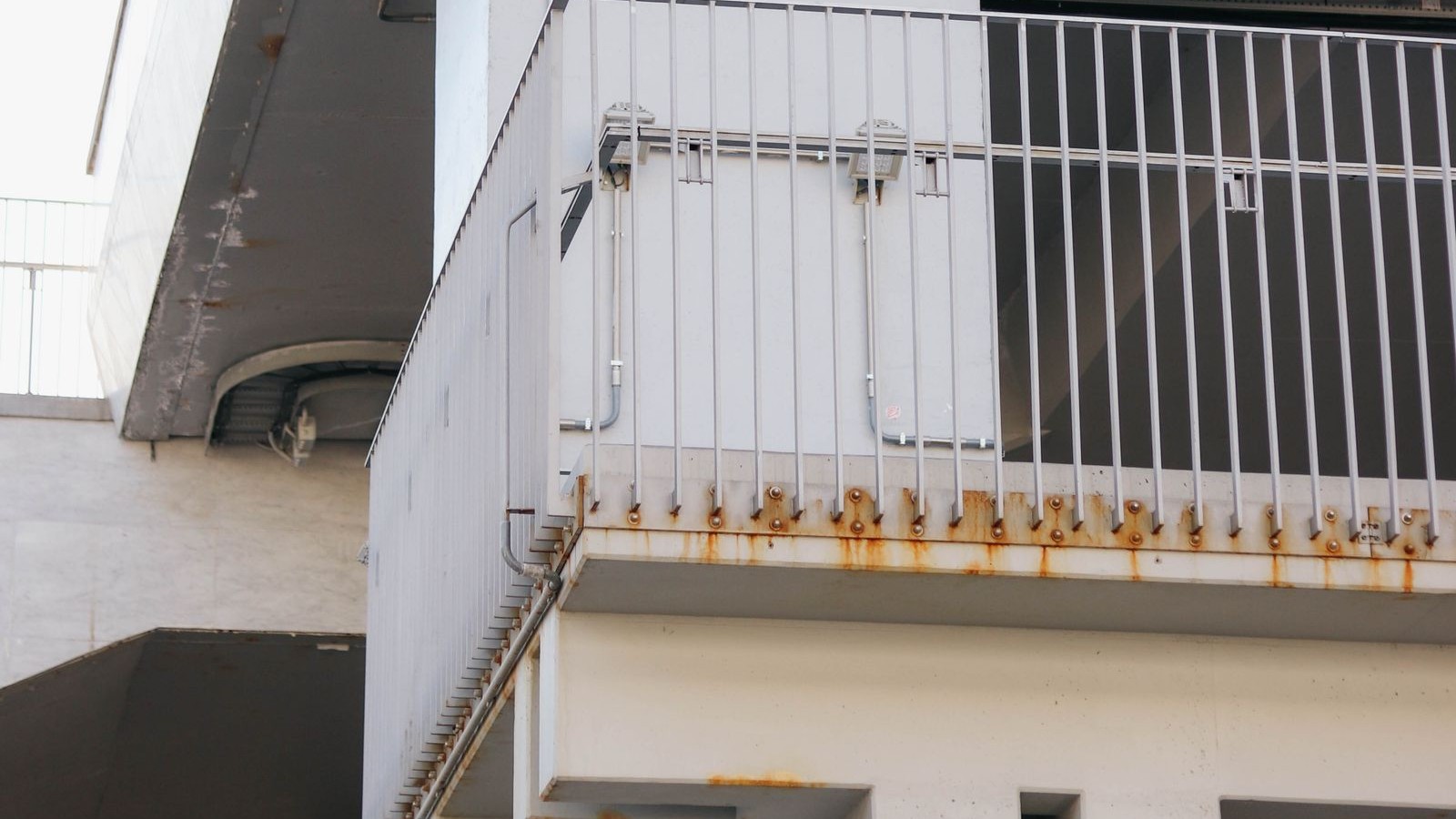
Rusting Railing Posts on Your Lanai: What Corroded Embeds Mean for the Concrete Around Them
Walk the perimeter of almost any Southwest Florida lanai built before 2000 and you will find the same thing: a thin rust-colored streak running down the concrete from the base of a railing post. Most owners read it as a cosmetic problem — the railing needs paint. On a coastal building, that streak is usually the first visible report from a piece of steel buried inside the slab, and by the time it reaches the surface it has already been working for a while.
Here is what those rust stains actually mean, why the concrete around the post matters more than the post itself, and what a board or property manager in Lee, Charlotte or Collier County should do about it before the next milestone inspection.
What an "embed" is, and why railings have one
A railing has to transfer load into the structure. On older SWFL balconies and lanais, that connection is usually one of three details:
- Wet-set posts. The post was stood in the forms and the slab was poured around it. Common on 1970s and 1980s construction and the hardest detail to repair well.
- Core-drilled and grouted posts. A hole was drilled into the slab or the top of the knee wall, the post dropped in, and the annular space packed with grout or non-shrink mortar.
- Surface-mounted base plates. A plate sits on top of the slab with expansion or adhesive anchors driven into the concrete. Newer and generally the most serviceable.
In the first two cases, steel is sitting inside the concrete with almost no cover on the outboard side — often an inch or less to the edge of the slab. That is the single most exposed position on the entire building envelope.
Why the rust doesn't stay where it starts
Concrete normally protects steel. Fresh concrete is highly alkaline, and that alkalinity forms a passive oxide film on the steel that stops corrosion cold. Two things break that protection on a coastal lanai:
- Chlorides. Salt-laden air off the Gulf lands on the balcony edge and dissolves into every rain event. Chloride ions migrate through the concrete's pore structure and strip the passive film off the steel, even where the concrete itself is still sound.
- Carbonation. Over decades, carbon dioxide reacts with the concrete's alkaline compounds and drops the pH from the surface inward. When the carbonation front reaches the steel, the protection goes with it.
Once the steel starts to corrode, the problem stops being chemistry and becomes mechanics. Iron oxide occupies several times the volume of the sound steel it replaced. That expansion has nowhere to go, so it pushes outward against the concrete around it — a few thousand psi of internal pressure against a material that has very little tensile strength. The concrete cracks. The crack lets in more water and more chloride. The corrosion accelerates. Restoration contractors call it the corrosion cycle, and it does not slow down on its own.
One detail that surprises a lot of owners: the same thing happens with aluminum railing posts set directly into concrete. Aluminum is attacked by the alkalinity of the cement paste, corrodes, and its corrosion product expands too. A post that will never "rust" in the way people picture can still split the slab edge it sits in.
What the concrete is telling you
The stain is the last symptom to appear, not the first. Walking a lanai, these are the signs worth photographing and dating:
- Rust bleed from the post base or base plate — the classic tell, and it means water has a path to steel.
- Fine cracks radiating from the post toward the slab edge or running parallel to the railing line. That crack pattern is expansion, not shrinkage.
- A hollow sound when the slab edge is tapped. Delamination — the concrete has separated internally but hasn't fallen yet.
- Tile or coating lifting near the railing, or a coating that has debonded in a band along the perimeter.
- Rust stains on the ceiling of the balcony below, which usually points to the slab's reinforcing steel rather than just the post.
- A post that moves when you push on the railing. Code expects that railing to resist a 200-pound concentrated load; a compromised embed cannot be assumed to still do it.
That last group matters most. The water path that reached the post embed usually reaches the slab's rebar too, because it is the same path: the unsealed joint at the post, the failed edge coating, the missing drip edge. When we open a balcony at the railing line, the repair almost never stops at the post.
Why re-caulking the post is not a repair
The most common shortcut in Southwest Florida is a bead of sealant around the base of each post, sometimes with a fresh coat of paint over the stain. It looks resolved for a season. The problem is that the corrosion is already inside the slab, and moisture inside concrete is not going anywhere in a Florida summer. Sealing the top of the pocket traps it against the steel and hides the crack growth from the next inspector who walks the building.
The same goes for grinding out the stain and patching with a cosmetic skim coat. If sound concrete is left in place around actively corroding steel, and the chloride-contaminated concrete is not removed, the patch simply relocates the failure — often to the perimeter of the new patch, within a couple of years.
What a correct repair looks like
Engineered concrete restoration at a railing line follows a sequence, and boards should expect to see it described in the scope they are bidding:
- Sounding and mapping. The full slab edge is sounded to find delaminated areas, which are marked and quantified. This is where the real repair quantity comes from — not from what is visible.
- Removal to sound concrete. Saw-cut perimeter, chip out the deteriorated and chloride-contaminated material, and undercut behind the steel so the repair mortar fully encapsulates it — typically about three-quarters of an inch of clearance all around.
- Steel evaluation. Corroded reinforcing is cleaned to bare metal, and any bar with meaningful section loss is supplemented or replaced per the engineer's direction.
- Post decision. In most cases the right answer is to remove the embedded post entirely and convert to a surface-mounted detail — a stainless or hot-dip galvanized base plate on a properly waterproofed slab, anchored with corrosion-resistant hardware. It takes the steel out of the concrete permanently.
- Protection. Zinc-rich or cementitious bonding and anti-corrosion coatings on exposed steel, then a polymer-modified structural repair mortar placed and cured properly — which in July in Fort Myers means real attention to cure, not just placement.
- Waterproofing last. A traffic-bearing or balcony coating with the terminations detailed correctly at the slab edge and around every new base plate, so the water path that started all of this is actually closed.
Done in that order, the railing and the concrete get solved together. Done out of order — new railings installed onto a slab that hasn't been repaired, or a coating applied over delaminated concrete — the community pays twice.
Where this intersects Milestone and SIRS
Rust staining and spalling at railing lines is one of the conditions a Phase 1 milestone inspector will note, and balcony and railing systems are among the components a Structural Integrity Reserve Study has to fund. Boards that document these areas early tend to get better outcomes in both processes: the condition is on record with photos and dates, the repair is scoped instead of estimated, and the reserve line item reflects a real number rather than a placeholder.
It also changes the bid conversation. Concrete restoration is priced with unit rates for unknown quantities, because nobody knows how much delaminated concrete is behind the stucco until it is opened. A board that has already had the perimeter sounded is negotiating from data. A board that hasn't is negotiating from a guess.
A practical sequence for boards and managers
If your lanais are showing rust at the posts, the useful next steps are simple:
- Photograph the affected posts and slab edges, unit by unit, with dates. A twelve-month photo record tells you the rate of change, which is often more informative than any single observation.
- Have the perimeter sounded and the conditions assessed before you solicit pricing, so every bidder is quoting the same scope.
- Coordinate the work with your painting and waterproofing cycle. Access equipment is a large share of the cost on a mid- or high-rise, and paying for it once instead of twice is the easiest money a board will ever save.
- Ask any contractor how they intend to handle the embedded posts specifically — remove and convert, or repair in place — and why.
McLeod's Construction, Paint & Restoration has been doing concrete and stucco restoration, waterproofing and high-rise painting for Southwest Florida communities for more than 30 years, working alongside engineers of record on occupied condo, HOA and commercial buildings across Lee, Charlotte and Collier Counties. If the rust streaks on your lanai have been there long enough that nobody remembers when they started, that is the right time to find out what is behind them.
Call (239) 282-0891 or request an assessment. You can also review our concrete and stucco restoration and waterproofing and sealants services, or see completed projects. Your Project. Our Passion.